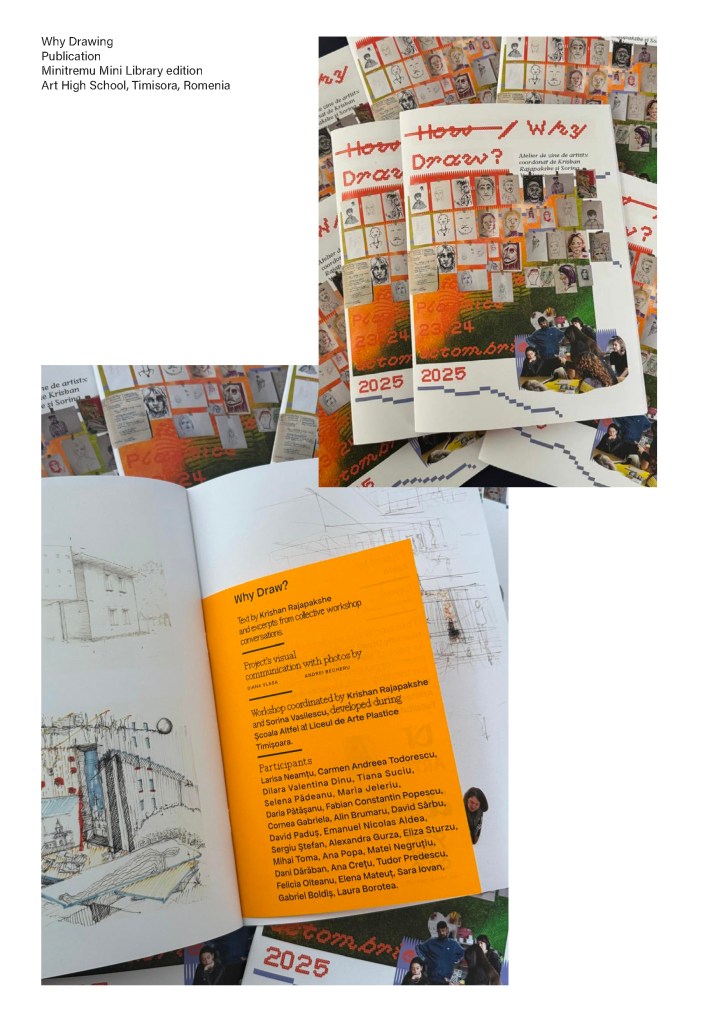
Minitremu Mini Library edition / Art High School, Timisora, Romenia
Why Drawing?
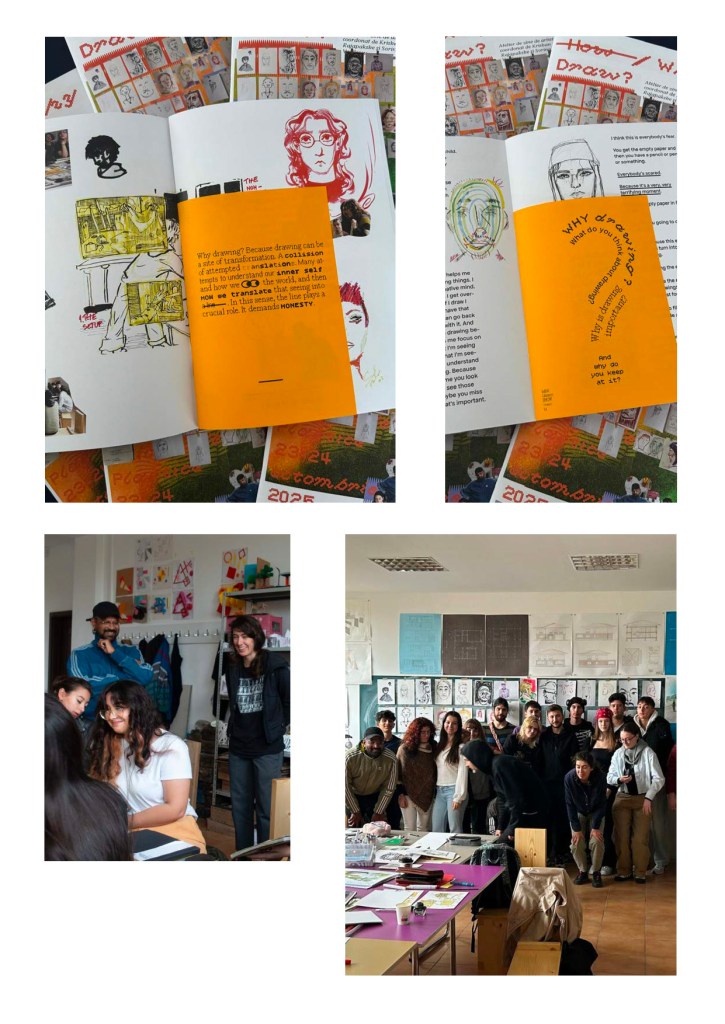
Why drawing? Because drawing can be a site of transformation. A collision of attempted translations. Many attempts to understand our inner self and how we see the world, and then how we translate that seeing into a line. In this sense, the line plays a crucial role. It demands honesty.
As Jean-Luc Nancy suggests, drawing can be understood as a site of philosophy, where thinking, body, time, and sense appear before meaning stabilizes. Drawing happens before interpretation becomes fixed. It happens before conclusions and, in that way, drawing becomes a way to understand coexistence: the coexistence of place, of our inner self, and our outer self. It allows us to sense how these spheres connect, overlap, or remain divided.
This is also where fear enters. Many people are terrified by drawing even before they put a finger or pencil on the paper. They make judgments about themselves before a single line exists: I cannot draw. Often this fear comes from understanding drawing as a copy machine, as reproduction, as something that must represent what is already there.
But drawing does not begin with the line. Drawing begins before the line. It happens in the head, in the body, in the space between seeing and moving. What we do on paper is not copying reality. It is translating energy, reflection, analysis, hesitation into movement.
The line does not reflect the object itself. The line reflects our understanding of it.
Thin line, thick line, dark line, light line. These are not aesthetic choices only. They are expressions of feeling, attention, pressure, doubt, confidence. They carry different states of understanding. That is why drawing is not about comfort. It is not about rest or beauty. Comfort does not belong to drawing. Beauty is not its goal.
Many people, especially students, get stuck because they worry about the viewer. They think about how to please, how to reassure, how to make something agreeable. But drawing is not about comforting the audience. It is about forming a language, often before language itself. Before interpretation. Before explanation.
A drawing can hold a single event, a series of events, or a collision of many things at once. That is where its power lies. Drawing is not a sub form of art. It is not preliminary. It is not soft. It is a complete form of life. It carries every essence of what we try to do as artists, thinkers, and bodies in the world.
At the same time, drawing holds openness. One drawing can exist for an entire lifetime. You can return to it, add to it, transform it daily. When to start and when to stop is a decision, but that decision is always reversible.
We can stare at a blank page for years without drawing a single line, and still be drawing. Drawing happens in thought, in attention, in refusal. That is where language starts again. That is where interpretation begins again. Meaning is not fixed. It keeps evolving.
The line is not a closed form. It keeps opening. It is open to intimate meanings and political meanings. To personal and public readings at the same time. That is why lines are political.
When we draw, we do not make images. We do not make pictures. Drawing is a gesture. It is a gesture of seeing, of thinking, of pressure, of hesitation. It is the body translating itself. The pressure of the hand, the interruption, the pause, the failure – these are not mistakes. They are part of the work.
Drawing is not a mystery. It is exposure. Lines expose a body of thinking.That thinking may be abstract, but it is always in motion. The hand moves. Thought moves from A to B. A drawing is a collection of movements. That is why drawing represents time. It is also contact. One dot touches another. One point moves toward another. Friction appears.
Drawing is not reality, but it is not outside reality either. It holds the fragments of reality and recomposes them. It creates fiction. And drawing, more than many other forms, creates the most fundamental structures of fiction.
Drawing is a form of thinking that cannot be separated from the body that performs it. What we draw and how we draw always reflects what the body is doing. This brings me back to Jean-Luc Nancy and the idea of pleasure. Pleasure is often misunderstood, reduced to beauty, comfort, satisfaction. A capitalist version of pleasure. But for Nancy, pleasure is not harmony. It is not reassurance. Pleasure exists in openness. In staying with confrontation, interruption, and risk.
Drawing carries this kind of pleasure. A pleasure that is inseparable from risk. The line may fail. It may stop. It may resist us. Drawing constantly moves between openness and closure. But even closure remains open. Pleasure exists precisely because nothing is guaranteed. And drawing strongly opposes the fix. It’s continuously becoming.
When we put a pencil to paper, nothing is promised. Only the movement itself. Only that moment. Drawing freezes time and at the same time releases it. Lines holds fragments of time, impulses, distractions. When we stand in front of a drawing later, we do not see the past moment of drawing. We encounter the present. The drawing becomes active again. It has the potential to transform whoever is in front of it.
Every drawing is an unfinished collision. Meaning is never complete. Knowledge keeps moving. Drawing resists logic. Step-by-step reasoning does not govern it. Logic imposes limits. Drawing refuses domination. It does not control the surface; it touches it. Drawing is not about mastering meaning. It is about participating in meaning.
Participation, not conclusion. Participation without closure. Drawing resists single truths. It resists hierarchical truth. It allows multiple truths to coexist. It does not impose interpretation. It does not dominate meaning. It remains emergent. Drawing is a body of thinking that keeps thinking. Keep moving. Keeps resisting closure – both external and internal.
So why drawing?
Because drawing allows us to engage, to emerge, to participate. As a gesture. As an exposure. Before representation. Before fixed meaning. Before domination. In this sense, drawing can be understood as a democratic form of knowledge production and aesthetic practice. It resists fixed meaning. It resists authority. It resists dominance.
Drawing does not finish meaning. It keeps it open.


Leave a Reply